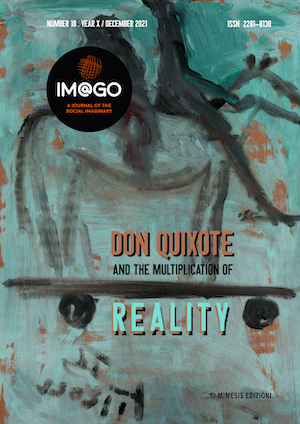
Don Chisciotte e la ferita della Modernità
DOI:
https://doi.org/10.7413/228181381906Palabras clave:
Imaginary | Modernity | Social Change and Art | Social Systems | ComplexityResumen
Quixote and the wound of Modernity.
Don Quixote, in addition to being a literary masterpiece, is also an inexhaustible epistemic reservoir that we need to draw on in order to understand what the relationship between imaginary and reality is made of and the peculiar way it is articulated in different eras, not only in Modernity. In this essay - from the perspective of Social Theory and the Social Change analysis - I will try to highlight how Cervantes' novel anticipates by many centuries what will be the most important epistemological (and aesthetic) acquisitions of the 20th century. Don Quixote is, from this point of view, a poetic treatise on the epistemology of complexity that reveals, in its folds, the mechanisms of functioning of complex systems and the paradoxes that are produced in them.
After mentioning what makes this work unique in the cultural landscape of any age, I will therefore dwell on its great epistemic legacy. In addition to having made it possible to highlight the existence of multiple realities (Schütz, 2008), it consists in having created an immortal mimetic device that ostensibly illustrates the co- essentiality and secret relationships between reality and the imaginary, anticipating the relational and systemic character of social reality and the risks that lurk in the inauspicious treatment of its complexity.
Descargas
Publicado
Número
Sección
Licencia
T
This work is distributed under the Creative Commons Attribution 4.0 International License.
The author retains the copyright to their contribution, while allowing anyone “to reproduce, distribute, communicate to the public, publicly display, perform, execute and recite the work”, provided that the author and the title of the journal are properly acknowledged.
At the time of submitting the publication proposal, the author is also required to declare that the content and structure of the work are original and do not in any way infringe upon the rights of third parties, nor the obligations related to the protection of the moral and economic rights of other authors or rights holders, whether concerning texts, images, photographs, tables, or any other parts of which the contribution may consist.
The author further declares that they are aware of the penalties provided for under the criminal code and special laws in the event of false statements in official documents and the use of false documents. Therefore, the journal shall be exempt from any liability of any kind, whether civil, administrative, or criminal, and the author shall hold the journal harmless from any request, claim, or demand made by third parties.
Authors who publish with this journal agree to the following terms:
- Authors retain copyright and grant the journal right of first publication with the work simultaneously licensed under a Creative Commons Attribution License that allows others to share the work with an acknowledgement of the work's authorship and initial publication in this journal.
- Authors are able to enter into separate, additional contractual arrangements for the non-exclusive distribution of the journal's published version of the work (e.g., post it to an institutional repository or publish it in a book), with an acknowledgement of its initial publication in this journal.
- Authors are permitted and encouraged to post their work online (e.g., in institutional repositories or on their website) prior to and during the submission process, as it can lead to productive exchanges, as well as earlier and greater citation of published work (See The Effect of Open Access).