
Vol. 15 (2025): The Performance of Objects II
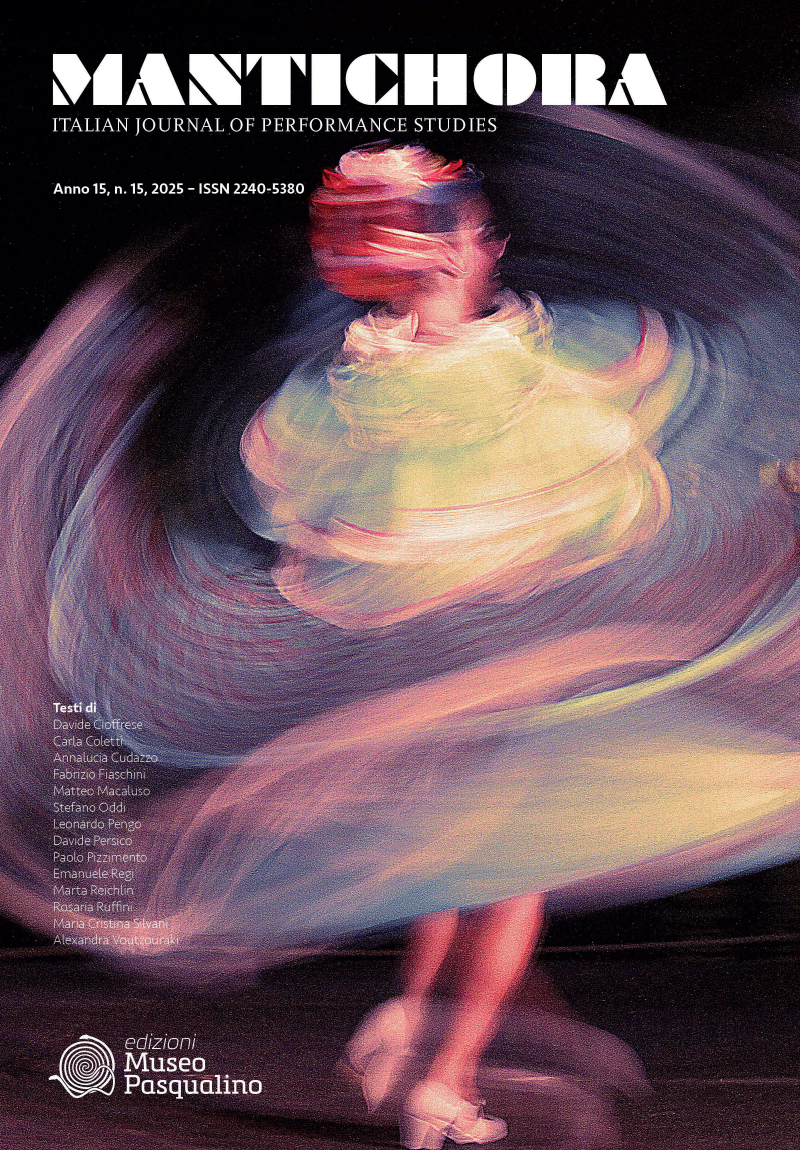
Although the contemporary climate situates the human being within an ever denser constellation of objects which, whether willingly or not, ultimately come to configure themselves as genuine extensions—both physical and cognitive—of body and mind,Mantichora’s decision to renew and deepen its focus on the performance of objects is certainly not driven by a kind of corresponding theoretical horror vacui On the contrary, the contributions collected in this issue provide further and convincing confirmation of the epistemic density of a field of inquiry that continues to prove fruitful, insofar as it brings together scholars from even distant disciplines and invites them to a substantial redefinition of methodologies and perspectives. Such a redefinition becomes necessary precisely in light of what the tangible concreteness of the objectual reference is capable of producing: a simultaneous effect both on the broad expanse of the epistemological horizon and on the narrower partitions of traditionally conceived disciplinary boundaries. At this point, it is worth adding that the short circuit established between the study of objects and the object of study proves particularly felicitous, and far from byzantine or merely self-referential. If it is true that this journal has always cultivated an explicit inclination toward transdisciplinary transgression, it is equally true that reconnecting to a precise indicator—to a determinate object—necessarily imposes a return, at times even forceful, to a form of adherence to the demands that such an object articulates. An adherence expressed in terms of an agency capable of conceptually redefining the environment within which the object itself is inscribed and acts. At its best—and this is certainly the case with the texts published here—this process confirms what was already observed in the previous issue: Performance Studies, in their attention to the inevitably contingent modalities of the processes that, from time to time, verify and test the given conditions of an artistic experience (and not only), represent not merely a disruption of any prefabricated method but also, paradoxically, the most honest and responsible form of rigor currently practicable. They thus take shape as a method that, precisely in its refusal of procedural crystallization, finds its critical strength and its epistemological legitimacy.
Published:
2026-04-02
