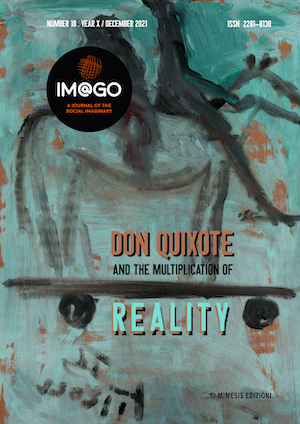
Io, Don Chisciotte di Fabrizio Monteverde: un racconto coreutico del capolavoro cervantino
DOI:
https://doi.org/10.7413/228181381917Parole chiave:
Narrative | Choreography | Virtuality | Actuality | UtopiaAbstract
Io, Don Chisciotte by Fabrizio Monteverde: a choreographic adaptation of Cervantes' masterpiece.
Object of this reflection is Io, Don Chisciotte, choreographed by Fabrizio Monteverde. The ballet is one of the most original contemporary terpsichorean versions of El ingenioso hidalgo Don Quijote de la Mancha, written by Miguel de Cervantes Saavedra. The choreographer exegete, thanks to the hermeneutic reworking of Cervantes’ themes, goes beyond the confines of the mere textual narration. He inscribes his own creation in the horizon outlined by the Spanish writer, who represents the overturned metaphysics, the tragic exemplarity, the all-encompassing sacredness, the achievable utopia, the relativizing truth. Monteverde is aware that the complex morality of Don Quixote must be re-functionalized through fruitful philological betrayals. He lets dialogue with Cervantes’ Weltanschauung the theoretical points of view -convergent, divergent, idiosyncratic- of the authors who have dedicated themselves to the critical examination of the masterpiece of the siglo de oro.
Dowloads
Pubblicato
Fascicolo
Sezione
Licenza
Quest'opera è distribuita con Licenza Creative Commons Attribuzione 4.0 Internazionale.
L'autore conserva il copyright sul suo contributo, consentendo tuttavia a chiunque "di riprodurre, distribuire, comunicare al pubblico, esporre in pubblico, rappresentare, eseguire e recitare l'opera", purché siano correttamente citati l'autore e il titolo della rivista.
L’autore, al momento della proposta di pubblicazione, è inoltre tenuto a dichiarare che il contenuto e l’organizzazione dell’opera è originale e non compromette in alcun modo i diritti di terzi, né gli obblighi connessi alla salvaguardia di diritti morali ed economici di altri autori o di altri aventi diritto, sia per testi, immagini, foto, tabelle, sia per altre parti di cui il contributo può essere composto. L’autore dichiara altresì di essere a conoscenza delle sanzioni previste dal codice penale e dalle leggi speciali per l’ipotesi di falsità in atti ed uso di atti falsi, e che pertanto la rivista è esente da qualsiasi responsabilità di qualsivoglia natura, civile, amministrativa o penale, e sarà dall'autore tenuta indenne da qualsiasi richiesta o rivendicazione da parte di terzi.