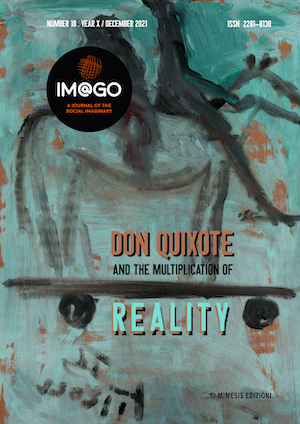
Il Chisciotte e i suoi lettori
DOI:
https://doi.org/10.7413/228181381912Parole chiave:
Chisciotte | Letture e riletture | Metafora | Innovazione semantica | Immaginario socialeAbstract
Don Quixote and Its Lectors.
The Don Quixote of la Mancha represents a literary work that never ceases to amaze and that offers material for reflection, continuously, influencing "the entire course of subsequent Western literature". An important source of inspiration, Don Quixote from La Mancha was able to feed both intellectual debate and popular culture. And this up to our days, in a plural way. The ability of this literary work to feed such a heterogeneity of streams leads to some considerations on reading, writing and on the status of classic to which a limited number of texts arrive. From a sociological perspective, this answer cannot be sought in the genius of the author or in some other similar characteristic, which would irremediably lead to focus on the individual. Rather, it must be sought in certain mechanisms of encounter and triggering of rearticulation processes, which have a relational, and therefore social, origin.
Dowloads
Pubblicato
Fascicolo
Sezione
Licenza
Quest'opera è distribuita con Licenza Creative Commons Attribuzione 4.0 Internazionale.
L'autore conserva il copyright sul suo contributo, consentendo tuttavia a chiunque "di riprodurre, distribuire, comunicare al pubblico, esporre in pubblico, rappresentare, eseguire e recitare l'opera", purché siano correttamente citati l'autore e il titolo della rivista.
L’autore, al momento della proposta di pubblicazione, è inoltre tenuto a dichiarare che il contenuto e l’organizzazione dell’opera è originale e non compromette in alcun modo i diritti di terzi, né gli obblighi connessi alla salvaguardia di diritti morali ed economici di altri autori o di altri aventi diritto, sia per testi, immagini, foto, tabelle, sia per altre parti di cui il contributo può essere composto. L’autore dichiara altresì di essere a conoscenza delle sanzioni previste dal codice penale e dalle leggi speciali per l’ipotesi di falsità in atti ed uso di atti falsi, e che pertanto la rivista è esente da qualsiasi responsabilità di qualsivoglia natura, civile, amministrativa o penale, e sarà dall'autore tenuta indenne da qualsiasi richiesta o rivendicazione da parte di terzi.