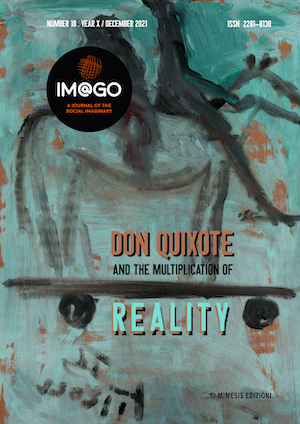
I mulini a vento della lettertura russa. La figura del Don Chisciotte nell'immaginario culturale slavo
DOI:
https://doi.org/10.7413/228181381910Parole chiave:
Slavic culture | Russian literature | Identity Nodes | Public Spheres | Donkišotstvovat’ ("to donquixote")Abstract
The windmills of Russian literature. The figure of Don Quixote in the Slavic cultural imagination.Literature in Russia has always performed a function of substantial importance, shaping up to be as one of the places in which the public sphere could most express itself. The materialization in the literary sphere of critical currents of thought and discursive practices by the intelligentsia has given rise to very animated debates that have profoundly affected Russian cultural life, even in the face of the presence of censorship more and more insidious, which amplified the passion with which the various issues were discussed. Among these, the relationship with Europe – and its 'cultural' products – has always embodied a central node in the identity definition of Russia itself.
Cervantes' novel also fits into this framework, presenting itself as one of the European works from which it is not possible to leave out of consideration. Its appearance triggers a "russification process" which will lead to a deepening of themes and characters, operating parallels and reformulations of figures and myths typical of Russian literature.
Dowloads
Pubblicato
Fascicolo
Sezione
Licenza
Quest'opera è distribuita con Licenza Creative Commons Attribuzione 4.0 Internazionale.
L'autore conserva il copyright sul suo contributo, consentendo tuttavia a chiunque "di riprodurre, distribuire, comunicare al pubblico, esporre in pubblico, rappresentare, eseguire e recitare l'opera", purché siano correttamente citati l'autore e il titolo della rivista.
L’autore, al momento della proposta di pubblicazione, è inoltre tenuto a dichiarare che il contenuto e l’organizzazione dell’opera è originale e non compromette in alcun modo i diritti di terzi, né gli obblighi connessi alla salvaguardia di diritti morali ed economici di altri autori o di altri aventi diritto, sia per testi, immagini, foto, tabelle, sia per altre parti di cui il contributo può essere composto. L’autore dichiara altresì di essere a conoscenza delle sanzioni previste dal codice penale e dalle leggi speciali per l’ipotesi di falsità in atti ed uso di atti falsi, e che pertanto la rivista è esente da qualsiasi responsabilità di qualsivoglia natura, civile, amministrativa o penale, e sarà dall'autore tenuta indenne da qualsiasi richiesta o rivendicazione da parte di terzi.