Immaginare il sacro
DOI :
https://doi.org/10.7413/228181381925Mots-clés :
Sacred, Imagination, Religion, Symbols, BeliefsRésumé
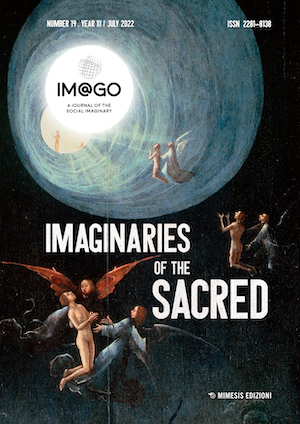
Imagining the Sacred.The imaginary would not seem to constitute an object of sociological investigation, as it is based on its abstract character. Unless one wishes to investigate it by passing through the subject itself, which imagines. The very variety of these multiple forms of acting, understood in a broad sense, presages a broad spectrum of possibilities, ranging from pure and simple inventiveness to the consolidation of a belief, which can become a reason for living, supported by a sacred dimension.
If there is one dimension of the sacred that fits well into the category of the imaginary, it is that defined by Rudolf Otto as numinous, that is mysterious and at the same time inspires awe and fascination, in short, it is mysterium tremendumet fascinans. What is mysterious and therefore hidden represents something grandiose, something majestic (from which majestas emanates), in other words something that is 'totally other' (das ganz Andere), which produces awe and no longer fear.
Téléchargements
Publiée
2022-10-19
Numéro
Rubrique
Topic
Licence
Authors who publish with this journal agree to the following terms:- Authors retain copyright and grant the journal right of first publication with the work simultaneously licensed under a Creative Commons Attribution License that allows others to share the work with an acknowledgement of the work's authorship and initial publication in this journal.
- Authors are able to enter into separate, additional contractual arrangements for the non-exclusive distribution of the journal's published version of the work (e.g., post it to an institutional repository or publish it in a book), with an acknowledgement of its initial publication in this journal.
- Authors are permitted and encouraged to post their work online (e.g., in institutional repositories or on their website) prior to and during the submission process, as it can lead to productive exchanges, as well as earlier and greater citation of published work (See The Effect of Open Access).