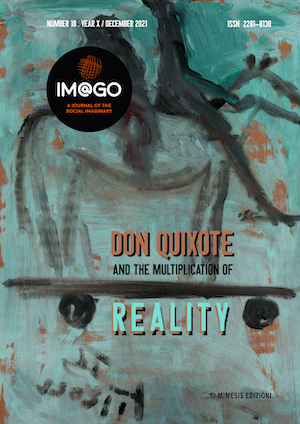
Don Chisciotte: la forza di gravità spirituale
DOI :
https://doi.org/10.7413/228181381918Mots-clés :
Mondi | Esperienza | Ferita originaria | Gravità | WellesRésumé
Don Quixote: the force of spiritual gravity.The article proposes to find the core of Cervantes’ novel in the illustration of the domination of one world over another. These two worlds are characterized for the different ways of confronting death as well as relating to the time that leads inexorably to it, as can be seen in Orson Welles’ cinematographic adaptation.
Don Quixote therefore is stated as being the incarnation of the force of spiritual gravity that moves the human being from its original wound: the propulsive melancholy of Don Quixote is (re)connected to the underlying condition of suffering that, from Heidegger to Abruzzese, up to Bovalino and Han, is a consequence of the human fragility to the inevitability of death. Assuming and admitting the original wound and the suffering connected to it could therefore today, in the electric era of the Network, be the only possibility of cum-essere.
Téléchargements
Publiée
Numéro
Rubrique
Licence
T
This work is distributed under the Creative Commons Attribution 4.0 International License.
The author retains the copyright to their contribution, while allowing anyone “to reproduce, distribute, communicate to the public, publicly display, perform, execute and recite the work”, provided that the author and the title of the journal are properly acknowledged.
At the time of submitting the publication proposal, the author is also required to declare that the content and structure of the work are original and do not in any way infringe upon the rights of third parties, nor the obligations related to the protection of the moral and economic rights of other authors or rights holders, whether concerning texts, images, photographs, tables, or any other parts of which the contribution may consist.
The author further declares that they are aware of the penalties provided for under the criminal code and special laws in the event of false statements in official documents and the use of false documents. Therefore, the journal shall be exempt from any liability of any kind, whether civil, administrative, or criminal, and the author shall hold the journal harmless from any request, claim, or demand made by third parties.
Authors who publish with this journal agree to the following terms:
- Authors retain copyright and grant the journal right of first publication with the work simultaneously licensed under a Creative Commons Attribution License that allows others to share the work with an acknowledgement of the work's authorship and initial publication in this journal.
- Authors are able to enter into separate, additional contractual arrangements for the non-exclusive distribution of the journal's published version of the work (e.g., post it to an institutional repository or publish it in a book), with an acknowledgement of its initial publication in this journal.
- Authors are permitted and encouraged to post their work online (e.g., in institutional repositories or on their website) prior to and during the submission process, as it can lead to productive exchanges, as well as earlier and greater citation of published work (See The Effect of Open Access).