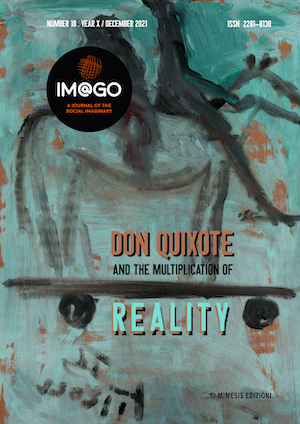
Don Chisciotte e la sfera pubblica immaginaria. Discorsi cavallereschi e nuove visioni nell’Europa dei tempi moderni
DOI :
https://doi.org/10.7413/228181381909Mots-clés :
Sfera pubblica letteraria | Immaginario | Mutamento | Intersoggettività | ModernitàRésumé
Don Quixote and the Public Sphere of the Imaginary. Chivalrous speeches and new visions in the Europe of modern times.
Don Quixote of La Mancha, by Miguel de Cervantes, is a privileged observatory in order to catch the imaginary of seventeenth-century Europe and the new ongoing sensitivities and ideas regarding social and cultural structures. By means Quixote's adventures and dialogue Cervantes puts in stage the origin of a discursive space that is emancipating itself from the aristocracy and is giving rise to a sphere of emancipation of new subjects. Together with it, Cervantes’ novel offers a literary space by which the reader can imagine his own possibility of participating in the public debate regarding the society of his time. Not just a book that tells the world, Don Quixote was also a means of questioning and overcoming it. He revealed the social word in its reality and unreality, as well as in its alternatives. Until the end, when the character who reads the books, Quixote, becomes the character of a book, a stereotype. The hidalgo loses his ability to act and discern, leaving us material which is still fertile and relevant to cast a critical look at contemporary society.
Téléchargements
Publiée
Numéro
Rubrique
Licence
T
This work is distributed under the Creative Commons Attribution 4.0 International License.
The author retains the copyright to their contribution, while allowing anyone “to reproduce, distribute, communicate to the public, publicly display, perform, execute and recite the work”, provided that the author and the title of the journal are properly acknowledged.
At the time of submitting the publication proposal, the author is also required to declare that the content and structure of the work are original and do not in any way infringe upon the rights of third parties, nor the obligations related to the protection of the moral and economic rights of other authors or rights holders, whether concerning texts, images, photographs, tables, or any other parts of which the contribution may consist.
The author further declares that they are aware of the penalties provided for under the criminal code and special laws in the event of false statements in official documents and the use of false documents. Therefore, the journal shall be exempt from any liability of any kind, whether civil, administrative, or criminal, and the author shall hold the journal harmless from any request, claim, or demand made by third parties.
Authors who publish with this journal agree to the following terms:
- Authors retain copyright and grant the journal right of first publication with the work simultaneously licensed under a Creative Commons Attribution License that allows others to share the work with an acknowledgement of the work's authorship and initial publication in this journal.
- Authors are able to enter into separate, additional contractual arrangements for the non-exclusive distribution of the journal's published version of the work (e.g., post it to an institutional repository or publish it in a book), with an acknowledgement of its initial publication in this journal.
- Authors are permitted and encouraged to post their work online (e.g., in institutional repositories or on their website) prior to and during the submission process, as it can lead to productive exchanges, as well as earlier and greater citation of published work (See The Effect of Open Access).