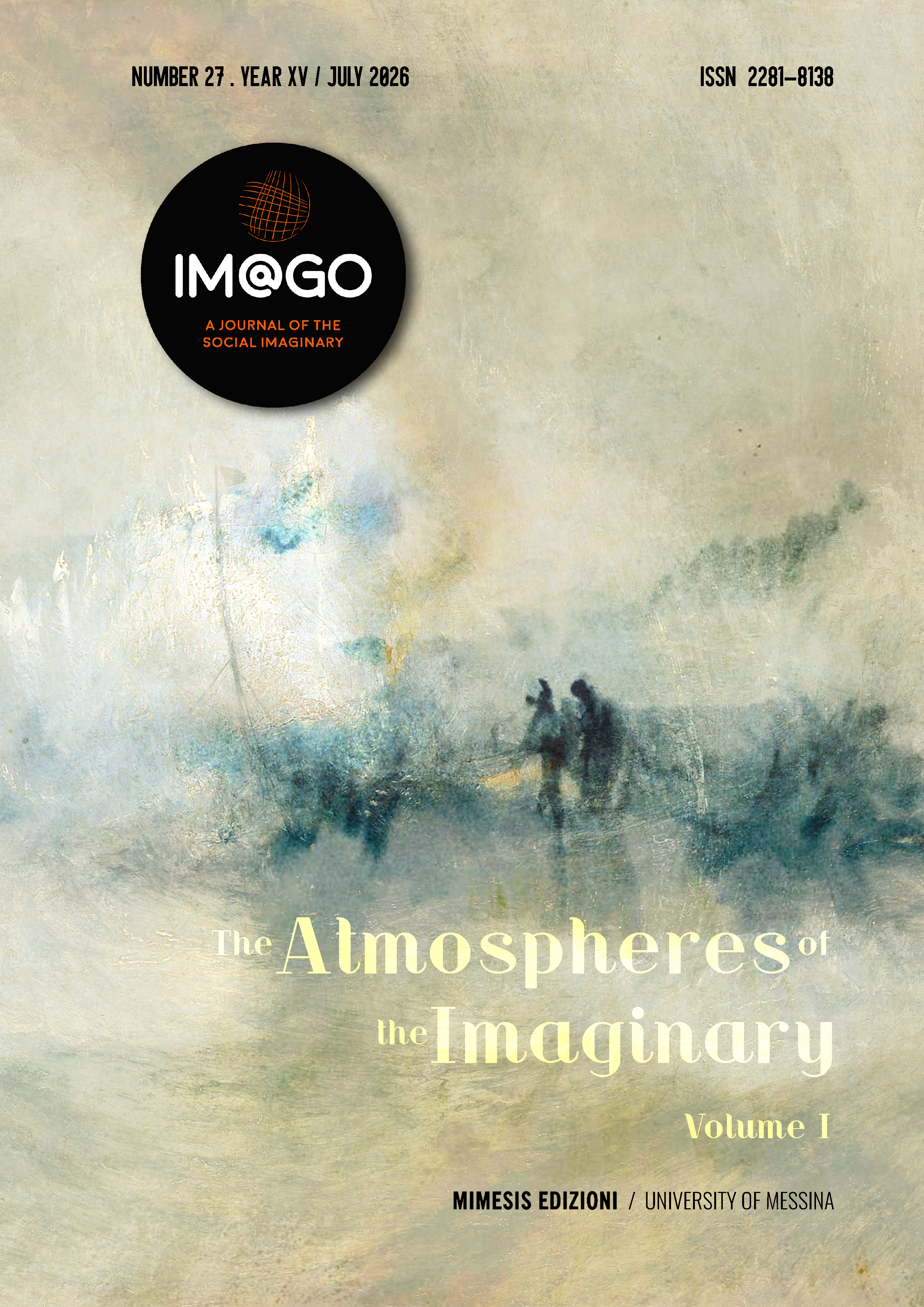
La città atmosferica: le forme sensibili di unimmaginario aiestetico
DOI :
https://doi.org/10.13129/2281-8138/2026.1.154-164Mots-clés :
Urban Imaginary , Atmosphere, Tonalities, Ambiances, PerceptionsRésumé
The notion of atmosphere must be understood as a phenomenological dynamic, offering a qualitative interpretation of reality and a vision of the world around us. Atmosphere constitutes an ontology of urban space to be grasped, in the spirit of the times, as something that determines an emotional and spatial flow generating affective qualities and different emotional tones. This means that the human body and the urban body are enveloped in a dynamic of affective reciprocity, thereby determining an aesthetic imaginary. This imaginary is formed by the tonal perceptions and predispositions of the body in situations experienced in the moments of their manifestation. The atmospheres emerging in everyday urban life are permanents in the situations in which the human body is projected. The city becomes an atmospheric universe, a surface of tonal places, and its interpretation a narrative conceived from sensations and emotions that resonate through multiple urban situations
Références
Augoyard J.F. (1979), Pas à pas, essai sur le cheminement quotidien en milieu urbain, Paris, Seuil.
Bachelard G. (1957), Poétique de l’espace, Paris, PUF.
Baudry P. Paquot Th. (ed.) (2003). L’urbain et ses imaginaires, Bordeaux, Maison des Sciences del’Homme d’’Aquitaine.
Böhme G. (2018), « L’atmosphère, fondement d’une nouvelle esthétique ? », Communication, N°102, pp.25-49
Böhme G. (2020), Aisthétique. Pour une esthétique de l’expérience sensible, Dijon, Les presses du réel.
Britto F.D., Jacques P.B. (2012), « Corpographies urbaines. Expériences, corps et ambiances » in Ambiances en acte(s) – International Congress on Ambiances, Montreal, pp.423-428.
Britto F.D., Jacques P.B. (2013), « Corpographies urbaines. Pour un urbanisme plus incorporé » in J.P. Thibaud, C.R. Duarte (dir.), Ambiances urbaines en partage. Pour une écologie sociale de la ville sensible, Genève, MetisPresses, pp.217-226.
Careri F. (2006), Walkscape. Camminare come pratica estetica, Torino, Einaudi
Calvino I. (1986), Il nome, il naso in Sotto il sole giaguaro, Milano, Garzanti
De Certeau (1980), L’invention du quotidien. Arts de faire, Paris, Union générale d’éditions.
Griffero T. (2014), “Estetica patica. Appunti per un’atmosferologia neofenomenolgica”, Studi di estetica, anon XLII, IV serie, Mimesis edizioni, pp.161-183.
Griffero T. (2017), Atmosferologia. Estetica degli spazi emozionali, Milano, 2a edizione, Mimesis.
Le Breton D. (2000), Éloge de la marche, Paris, Métailié.
Le Breton D. (2006), La saveur du monde. Une anthropologie des sens, Paris, Métailié
Minkowski E. (1995), Le temps vécu, Paris, PUF.
Pallasmaa J. (1996), The Eyes of the Skin. Architecture and the Senses, London, Academy Editions.
Pallasmaa J. (2017), « Percevoir et ressentir les atmosphères. L’expérience des espaces et des lieux » in Architecture, espace, aisthesis, M. Galland-Szymkowiak (dir.), Revue Phantasia.
Perec G. (1974), Espèce d’espace, Paris, Galilée.
Sansot P. (1971), Poétique de la ville, Paris, Klincksieck.
Schmitz H.. (2011), Nuova Fenomenologia. Un’introduzione, tr. it. E cura di T. Griffero, Milano, Marinotti.
Schmitz H. (2019), « L’atmosphère d’une ville », tr. fr. Mildred Galland-Szymkowiak, Les Cahiers philosophiques de Strasbourg, 46, pp.147-167.
Schmitz H. (2023), Atmosphères, trad. di J.L. Georget, P. Grosos, Paris, Vrin.
Schulze G. (2008), The Experience Society, London, Sage Publicaiton.
Simmel G. (1903) Die Großstädte und das Geistesleben, Dresden, Petermann. Trad. it. La metropoli e la vita dello spirito (1995), a cura di Paolo Jedlowski, Roma, Armando Editore.
Solnit R. (2000), Wanderlust : A History of Walking, New York, Penguin.
Tellenbach H. (1985), Goût et atmosphère, Paris, PUF, 1985.
Thibaud J.P. (2015), En quête d’ambiances. Éprouver la ville en passant, Genève, MetisPresses.
Von Uexküll J., Kriszat G. (1967), Ambiente e comportamento, tr. it. P. Manfredi, Milano, Il Saggiatore.
Téléchargements
Publiée
Numéro
Rubrique
Licence
(c) Copyright Fabio La Rocca 2026

Ce travail est disponible sous la licence Creative Commons Attribution 4.0 International .
T
This work is distributed under the Creative Commons Attribution 4.0 International License.
The author retains the copyright to their contribution, while allowing anyone “to reproduce, distribute, communicate to the public, publicly display, perform, execute and recite the work”, provided that the author and the title of the journal are properly acknowledged.
At the time of submitting the publication proposal, the author is also required to declare that the content and structure of the work are original and do not in any way infringe upon the rights of third parties, nor the obligations related to the protection of the moral and economic rights of other authors or rights holders, whether concerning texts, images, photographs, tables, or any other parts of which the contribution may consist.
The author further declares that they are aware of the penalties provided for under the criminal code and special laws in the event of false statements in official documents and the use of false documents. Therefore, the journal shall be exempt from any liability of any kind, whether civil, administrative, or criminal, and the author shall hold the journal harmless from any request, claim, or demand made by third parties.
Authors who publish with this journal agree to the following terms:
- Authors retain copyright and grant the journal right of first publication with the work simultaneously licensed under a Creative Commons Attribution License that allows others to share the work with an acknowledgement of the work's authorship and initial publication in this journal.
- Authors are able to enter into separate, additional contractual arrangements for the non-exclusive distribution of the journal's published version of the work (e.g., post it to an institutional repository or publish it in a book), with an acknowledgement of its initial publication in this journal.
- Authors are permitted and encouraged to post their work online (e.g., in institutional repositories or on their website) prior to and during the submission process, as it can lead to productive exchanges, as well as earlier and greater citation of published work (See The Effect of Open Access).