Reinventare la Natura: il caso del Neopaganesimo
DOI :
https://doi.org/10.7413/22818138170Mots-clés :
Neo-paganism | Religion | Spirituality | Nature| EcologyRésumé
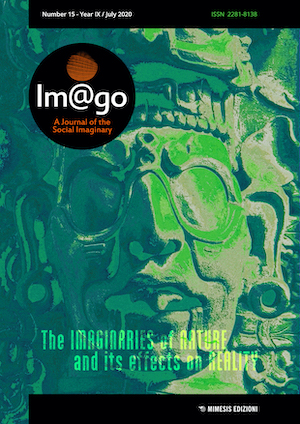
Re-inventing Nature: the case of Neo-paganism. The article is an analysis of how the development of Neo-paganism, a new religious movement, modifies the perception of Nature of its followers. Neo-paganism is a group of polytheistic cults coming from pre-Christian traditions. One of the common principles is to be a nature-based religion, this means that Nature is the center of veneration. One of its multiple roots is in the rediscovery of the ancient Celtic past that begins in the UK at the end of the eighteenth century and develops inheriting the whole Romantic imaginary. Neo-paganism became a proper spiritual movement during the second half of the Fifties. In the Sixties there is another evolution that brings a change of perspective thanks to the rise of ecological awareness. The human being is put inside the natural world recalling an ancient mythical past where the coexistence was symbiotic, and it is constantly evoked a sense of debt and duty in front of an abused Mother Nature that is always good and fair.
Téléchargements
Publiée
Numéro
Rubrique
Licence
Authors who publish with this journal agree to the following terms:- Authors retain copyright and grant the journal right of first publication with the work simultaneously licensed under a Creative Commons Attribution License that allows others to share the work with an acknowledgement of the work's authorship and initial publication in this journal.
- Authors are able to enter into separate, additional contractual arrangements for the non-exclusive distribution of the journal's published version of the work (e.g., post it to an institutional repository or publish it in a book), with an acknowledgement of its initial publication in this journal.
- Authors are permitted and encouraged to post their work online (e.g., in institutional repositories or on their website) prior to and during the submission process, as it can lead to productive exchanges, as well as earlier and greater citation of published work (See The Effect of Open Access).