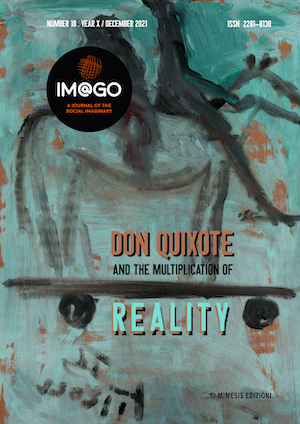
Don Chisciotte (im)politico. Usi e abusi del cavaliere errante di Cervantes nell’immaginario politico del Novecento e della postmodernità
DOI :
https://doi.org/10.7413/228181381911Mots-clés :
Realism | Politics/polity | Postmodernism | Social Imaginary | PopulismsRésumé
The (Im)political Don Quijote. Usages and abuses of the Cervantes’ knight-errant along Twentieth and postmodern imaginery.
The legacy of Cervantes’ masterpiece has been very influential on literary and narratological imaginary. And the Miguel de Cervantes’ fictional character has disseminated elements of criticism over time with respect to several of the mechanistic dichotomies of the genesis of modernity. During Nineteenth and Twentieth century we could observe the progressive enlargement of its influence on an alternative kind of imaginery, that is to say the political one. This article aims to analyze the political reflections and, especially, the impolitical ones around the «antihero» knight-errant and «subtle hidalgo». From the first political interpretation made by French Enlightment to the central season of the crisis of Spanish culture and civilization (Unamuno, Ortega y Gasset, Castro), until the contemporary postmodernism and the rediscovery of Don Quijote’s relativism.
Téléchargements
Publiée
Numéro
Rubrique
Licence
T
This work is distributed under the Creative Commons Attribution 4.0 International License.
The author retains the copyright to their contribution, while allowing anyone “to reproduce, distribute, communicate to the public, publicly display, perform, execute and recite the work”, provided that the author and the title of the journal are properly acknowledged.
At the time of submitting the publication proposal, the author is also required to declare that the content and structure of the work are original and do not in any way infringe upon the rights of third parties, nor the obligations related to the protection of the moral and economic rights of other authors or rights holders, whether concerning texts, images, photographs, tables, or any other parts of which the contribution may consist.
The author further declares that they are aware of the penalties provided for under the criminal code and special laws in the event of false statements in official documents and the use of false documents. Therefore, the journal shall be exempt from any liability of any kind, whether civil, administrative, or criminal, and the author shall hold the journal harmless from any request, claim, or demand made by third parties.
Authors who publish with this journal agree to the following terms:
- Authors retain copyright and grant the journal right of first publication with the work simultaneously licensed under a Creative Commons Attribution License that allows others to share the work with an acknowledgement of the work's authorship and initial publication in this journal.
- Authors are able to enter into separate, additional contractual arrangements for the non-exclusive distribution of the journal's published version of the work (e.g., post it to an institutional repository or publish it in a book), with an acknowledgement of its initial publication in this journal.
- Authors are permitted and encouraged to post their work online (e.g., in institutional repositories or on their website) prior to and during the submission process, as it can lead to productive exchanges, as well as earlier and greater citation of published work (See The Effect of Open Access).