La pandemia nei sogni
DOI:
https://doi.org/10.7413/22818138190Palabras clave:
Imaginary, Dreams, | Jung, Cultural Sociology, PandemicResumen
The pandemic within dreams.
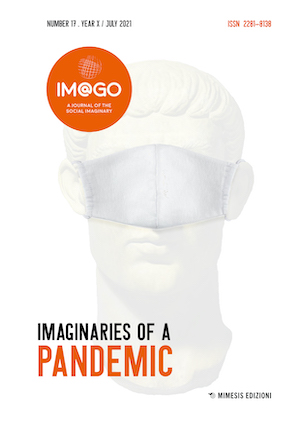
The article aims to analyse different representations of the pandemic within dreams to trace correspondences between the symbolic expressions of the oneiric language and the sociology of the imaginary. The theoretical-methodological framework of Carl G. Jung and Marie-Louise von Franz guides the articulation of the essay. The unconscious lived through the memory of dreams has the typical and strong tendency to be projected externally, hence the hypothesis that it is possible to grasp its reflections in external reality and the social world. The question to be answered concerns which shared movements are present in the unconscious of individual subjects during the current period dominated by the pandemic and which relationships can be detected between the symbolic material emerging in individual dreams and some contemporary cultural phenomena. The empirical material is drawn from a series of interdisciplinary meetings regarding patients' dreams during the pandemic.
Descargas
Publicado
Número
Sección
Licencia
Authors who publish with this journal agree to the following terms:- Authors retain copyright and grant the journal right of first publication with the work simultaneously licensed under a Creative Commons Attribution License that allows others to share the work with an acknowledgement of the work's authorship and initial publication in this journal.
- Authors are able to enter into separate, additional contractual arrangements for the non-exclusive distribution of the journal's published version of the work (e.g., post it to an institutional repository or publish it in a book), with an acknowledgement of its initial publication in this journal.
- Authors are permitted and encouraged to post their work online (e.g., in institutional repositories or on their website) prior to and during the submission process, as it can lead to productive exchanges, as well as earlier and greater citation of published work (See The Effect of Open Access).