Forensic Geology applied to criminal investigation: A case report
DOI:
https://doi.org/10.1478/AAPP.101S1A9Keywords:
Forensic Geology, Micropalaeontology, Foraminifera, Criminalistics, Forensic Sciences, Comparative Analyses, Provenance, Mixed Physical EvidenceAbstract
The present research was devoted to the geological study of two forensic samples of geological evidence collected on the belongings of a victim of gun shooting, found in a rural area of the countryside in southern Italy. Geological analyses on these granular samples were requested in order to ascertain the possible provenance of the evidence. The results of mineralogical, sedimentological, and micropalaeontological investigation on the clasts/grains indicated that the geological evidence presumably originated from an area where outcrops of sedimentary, metamorphic, and volcanic rocks were present. The petrographic characters of the clasts made up of metamorphic rocks were compatible with the crystalline basements of the Calabria-Peloritani Arc (southern Italy). An important constraint in the specimens was the presence of very peculiar grains of volcanic rocks compatible with those of pyroclastic products of the Mount Etna. Another important constraint was represented by the finding of benthic foraminifers, released by a marly-clayey aggregate. These foraminifera are common in grey-blue clays passing laterally to the calcareous sands cropping out in the Messina province along the Tyrrhenian and the Ionian coasts. In conclusion, the studied geological evidence, notwithstanding one of the samples was of mixed origin, could geographically derive from an area of the Calabria-Peloritani Arc. In particular the material found in one of the samples could derive from an area not too far from the coast and where Etna volcano ashes could also arrive and deposit.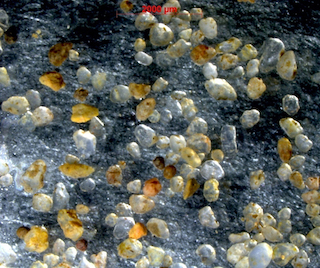
Downloads
Published
2023-09-12
Issue
Section
Advances and Applications in Geoforensics: Unraveling Crimes with Geology (Conference Proceedings)
License

This work is licensed under a Creative Commons Attribution 4.0 International License.
- Authors retain copyright and grant the journal right of first publication with the work simultaneously licensed under a Creative Commons Attribution License that allows others to share the work with an acknowledgement of the work's authorship and initial publication in this journal.
- Authors are able to enter into separate, additional contractual arrangements for the non-exclusive distribution of the journal's published version of the work (e.g., post it to an institutional repository or publish it in a book), with an acknowledgement of its initial publication in this journal.
- Authors are permitted and encouraged to post their work online (e.g., in institutional repositories or on their website) prior to and during the submission process, as it can lead to productive exchanges, as well as earlier and greater citation of published work (See The Effect of Open Access).