Forme e tropi dell’immaginario dell’Intelligenza Artificiale: il contributo della filosofia di Yuk Hui
DOI:
https://doi.org/10.7413/2281813819589Palabras clave:
Artificial Intelligence, Social Imaginary, Representation, Science Fiction, Yuk HuiResumen
Forms and tropes of Artificial Intelligence imagery: the contribution of Yuk Hui's philosophy.
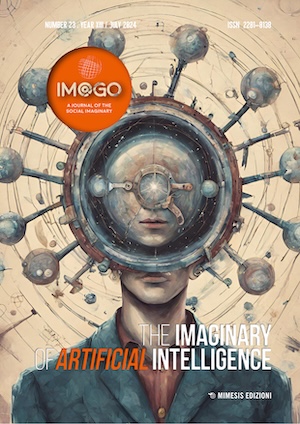
The article explores the genealogy of artificial intelligence (AI) imaginary through the analysis of tropes and forms that have influenced its social perception. By analysing how cultural texts represent AI, the difference between past images and current epistemic definitions of technology is highlighted. Yuk Hui's contribution is crucial in understanding the discrepancies between the traditional representation of AI, based on western myths, and different cosmo-visions. Hui highlights how the imagery of AI is often limited by an anthropocentric view that ignores its real dynamics. Our hypothesis is that many of today's representations of AI derive from an idea of human as unique agency, making it difficult to create innovative and authentic narratives over pre-existing and sedimented forms.
Referencias
Alegre, S. (2024) Human rights, robots wrongs: being human in the age of AI, London, Atlantic Books.
Atanasoski, N., Vora, K. (2019) Surrogate Humanity: Race, Robots, and the Politics of Technological Futures, New York, Duke University Press.
Boccia Artieri, G. (2017). “Algoritmi e Bolle: La Comunicazione nell'Epoca della Personalizzazione”, in Trione, C. (Ed.), Società e Comunicazione nell’Era Digitale, Milano, Mondadori, 73-90.
Boccia Artieri, G. (2020), “Prosumption 2.0: Produzione e Consumo nell’Era delle Piattaforme Digitali”, in Golinelli, S. (Ed.), Società della Conoscenza e Digitalizzazione, Bologna: Il Mulino, 45-62.
Bo-Young, K. (2023), L’origine delle specie, Torino, ADD.
Brown, F. (1961), “La risposta”, in Fruttero, C., Lucentini, F. (eds.), Il secondo libro della fantascienza. Le meraviglie del possibile, Torino, Einaudi, 349-350
Buongiorno, F. (2024), “Fenomenologia delle reti neurali. Per un concetto polisemico di intelligenza (artificiale)”, in Galletti, M., Zipoli Caiani, S. (eds.), Filosofia dell’Intelligenza Artificiale. Sfide etiche e teoriche, Bologna, Il Mulino.
Canclini, N.G. (2021), Cidadãos substituídos por algoritmos, São Paulo, Edusp.
Čapek, K. (2023) R.U.R, Boston, MIT.
Caronia, A. (2020), Dal cyborg al postumano, Milano, Meltemi.
Cassino, J.F., Souza, J. e Silveira, S.A. (2021), Colonialismo de dados: como opera a trincheira algorítmica na guerra neoliberal. São Paulo, Autonomia Literária.
Casarino, L. (2022), O mundo do avesso. Verdade e política na era digital, São Paulo, UBU.
Clarke, A.C. (1987) 2001: Odissea nello spazio, Milano, Longanesi.
Couldry, N., Mejias, U.A. (2019), The costs of connection: how data is colonizing human life and appropriating it for Capitalism, Stanford, Stanford University Press.
Cristianini, N. (2023), La scorciatoia: Come le macchine sono diventate intelligenti senza pensare in modo umano, Bologna, Il Mulino.
Cristianini, N. (2024), Machina Sapiens: L’algoritmo che ci ha rubato il segreto della conoscenza, Bologna, Il Mulino.
Davison, F., Lippold, W. (2023), Colonialismo digital: por uma crítica hacker fanoniana, São Paulo, Boitempo.
Derrida, J. (2016), A escritura e a diferença, São Paulo, Perspectiva.
Dick, P.K. (1955) “Autofac”, in Galaxy. Science Fiction, 11, https://archive.org/details/Galaxy_v11n02_1955-11
Elliott, A. (2021) La cultura dell’intelligenza artificiale – Vita quotidiana e rivoluzione digitale, Torino, Codice.
Fabris, A. (2012), Etica delle nuove tecnologie, Brescia, La Scuola.
Haraway, D.J. (1995), Manifesto cyborg: donne, tecnologia e biopolitiche del corpo, Milano, Feltrinelli.
Herbert, F. (2019), Dune, Roma, Fanucci.
Hjarvard, S. (2013), The mediatization of culture and society, Abington, Routledge.
Hoffmann, E.T.A. (2019), L’uomo della sabbia e altri racconti, Milano, Mondadori.
Hui, Y. (2020), Tecnodiversidade, São Paulo, UBU.
Italiano, G.F., Prati, E. ”Storia, tassonomia e sfide future dell’intelligenza artificiale”, in Severino, P. (ed.), Intelligenza artificiale. Politica, economia, diritto, tecnologia, Roma, Luiss, 29-40.
Jodelet, D. (2003). Représentations sociales Un domaine en expansion: Vol.1 7e éd. Presses Universitaires de France. (https://www.cairn.info/les-representations-sociales--9782130537656-page-45.htm ).
Koselleck, R. (2006) Futuro passado: contribuições à semântica dos tempos históricos, Rio de Janeiro, Contraponto/PUC-Rio.
Latour, B. (2005), Pandora's Hope, Harvard, Harvard University Press.
Le Guin, U.K. (2010), The word for the world is forest, New York, Tor.
Marcone, J. (2017), “The stone guest. Buen vivir and popular environmentalisms in the Andes and Amazonia”, in Heise, U.K., Chrietensen, J., Niemann, M. (eds.), The Routledge companion to environmental humanities, New York, Routledge, 227-236.
Martel, F. (2015), Smart: inchiesta sulle reti. Milano, Feltrinelli.
Marzo, P.L., Mori, L. (2019), Le vie sociali dell’immaginario – Per una sociologia del profondo, Milano, Mimesis.
Morozov, E. (2019), Big tech: a ascenção dos dados e a morte da política. São Paulo, Ubu.
Nemer, D. (2021), Tecnologia do oprimido: desigualdade e o mundano digital nas favelas do Brasil, Milfontes, Vitória.
O’Neil, C. (2020), Algoritmos de destruição em massa: como o big data aumenta a desigualdade e ameaça a democracia. Santo André, rua do Sabão.
Turing, A.M. (1950) “Computer Machinery and intelligence”, in Mind, n. 236, v. 59, 1 out., 433-460.
Ugarte, D. (2008), O poder das redes, Porto Alegre, EdiPUCRS.
Wiener, N. (1953), Introduzione alla cibernetica, Torino, Bollati Boringhieri.
Zuboff, S. (2020), Il capitalismo della sorveglianza. Il futuro dell’umanità nell’era dei nuovi poteri, Roma, Luiss.
Descargas
Publicado
Número
Sección
Licencia
T
This work is distributed under the Creative Commons Attribution 4.0 International License.
The author retains the copyright to their contribution, while allowing anyone “to reproduce, distribute, communicate to the public, publicly display, perform, execute and recite the work”, provided that the author and the title of the journal are properly acknowledged.
At the time of submitting the publication proposal, the author is also required to declare that the content and structure of the work are original and do not in any way infringe upon the rights of third parties, nor the obligations related to the protection of the moral and economic rights of other authors or rights holders, whether concerning texts, images, photographs, tables, or any other parts of which the contribution may consist.
The author further declares that they are aware of the penalties provided for under the criminal code and special laws in the event of false statements in official documents and the use of false documents. Therefore, the journal shall be exempt from any liability of any kind, whether civil, administrative, or criminal, and the author shall hold the journal harmless from any request, claim, or demand made by third parties.
Authors who publish with this journal agree to the following terms:
- Authors retain copyright and grant the journal right of first publication with the work simultaneously licensed under a Creative Commons Attribution License that allows others to share the work with an acknowledgement of the work's authorship and initial publication in this journal.
- Authors are able to enter into separate, additional contractual arrangements for the non-exclusive distribution of the journal's published version of the work (e.g., post it to an institutional repository or publish it in a book), with an acknowledgement of its initial publication in this journal.
- Authors are permitted and encouraged to post their work online (e.g., in institutional repositories or on their website) prior to and during the submission process, as it can lead to productive exchanges, as well as earlier and greater citation of published work (See The Effect of Open Access).