Immaginario urbano ed epidemie
DOI:
https://doi.org/10.7413/22818138189Palabras clave:
Imaginary, Cities, Epidemic, Urban Experience, Urban RegenerationResumen
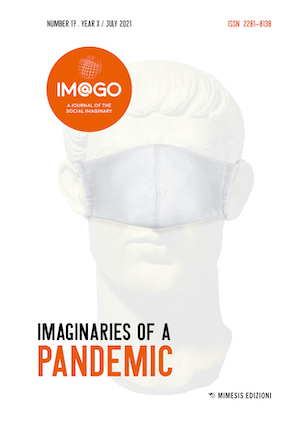
Urban Imaginary and Epidemic.
Richard Williams writes provocatively, we live in a second-hand world. Our experience is filtered, consciously or not, by the imaginary that becomes the basis of our definition of reality and therefore of our daily decisions and behaviors, the criterion of meaning through which we look at the world and at ourselves.
The Covid-19 pandemic has been experienced on the imaginary level. Even the younger generations who have not experienced the last great pandemic, still had a representation of the epidemics, built by the diaries of the great travelers, from literary narratives, and above all from films and TV series, within which they found themselves as catapulted.
This latest epidemic, not unlike any other that has ravaged history, has lived and strengthened the symbolic link with the city. In particular, it is the empty spaces of the denied city that have played a central role in building the imagination of the current epidemic as well. As in the past, the cities emerge from this dramatic experience as the undisputed protagonists, scenarios in which every memory of the epidemic will continue to take shape, remaining, once more, inextricably linked.
Descargas
Publicado
Número
Sección
Licencia
T
This work is distributed under the Creative Commons Attribution 4.0 International License.
The author retains the copyright to their contribution, while allowing anyone “to reproduce, distribute, communicate to the public, publicly display, perform, execute and recite the work”, provided that the author and the title of the journal are properly acknowledged.
At the time of submitting the publication proposal, the author is also required to declare that the content and structure of the work are original and do not in any way infringe upon the rights of third parties, nor the obligations related to the protection of the moral and economic rights of other authors or rights holders, whether concerning texts, images, photographs, tables, or any other parts of which the contribution may consist.
The author further declares that they are aware of the penalties provided for under the criminal code and special laws in the event of false statements in official documents and the use of false documents. Therefore, the journal shall be exempt from any liability of any kind, whether civil, administrative, or criminal, and the author shall hold the journal harmless from any request, claim, or demand made by third parties.
Authors who publish with this journal agree to the following terms:
- Authors retain copyright and grant the journal right of first publication with the work simultaneously licensed under a Creative Commons Attribution License that allows others to share the work with an acknowledgement of the work's authorship and initial publication in this journal.
- Authors are able to enter into separate, additional contractual arrangements for the non-exclusive distribution of the journal's published version of the work (e.g., post it to an institutional repository or publish it in a book), with an acknowledgement of its initial publication in this journal.
- Authors are permitted and encouraged to post their work online (e.g., in institutional repositories or on their website) prior to and during the submission process, as it can lead to productive exchanges, as well as earlier and greater citation of published work (See The Effect of Open Access).