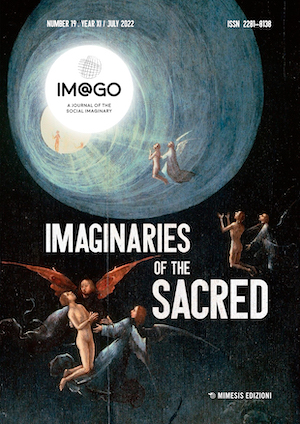
I “regimi immaginali” del sacro. Religione, spiritualità, trascendenza: un’analisi di sociologia della religione e dell’immaginario
DOI:
https://doi.org/10.7413/228181381924Parole chiave:
Sacred, Imagery, Transcendence, Religion, SpiritualityAbstract
The Sacred and the “Regimes of the Imaginary”. Religion, Spirituality, Transcendence: an Analysis from the Perspective of the Sociology of Religion and Imagery.The aim of this essay is to analyze the relationship between different “regimes of the imaginary” (Durand, 2013) and the sacred.
In the first section, I underline the features in common between the domain of the sacred and that of the imaginary; in the second, I identify the “axial” epoch as the genetic moment of the “diurnal regime” (Durand, 2013) highlighting the concurrence of the emergence of the transcendent sphere; in the third, I analyze the passage of the symbolic power of the “disjunction” from the sacred to the scientific imaginary; in the fourth, I discuss two typical forms of social relationship with the sacred in contemporary society, hypothesizing that religion, maintaining a relationship with the transcendent sphere, is still inscribed today in a “diurnal” imaginary while, spirituality, by having its relationship with the sacred only in the immanent dimension, it represents a contemporary form of “nocturnalization of experience”, paraphrasing an expression by Gilbert Durand.
Dowloads
Pubblicato
Fascicolo
Sezione
Licenza
Quest'opera è distribuita con Licenza Creative Commons Attribuzione 4.0 Internazionale.
L'autore conserva il copyright sul suo contributo, consentendo tuttavia a chiunque "di riprodurre, distribuire, comunicare al pubblico, esporre in pubblico, rappresentare, eseguire e recitare l'opera", purché siano correttamente citati l'autore e il titolo della rivista.
L’autore, al momento della proposta di pubblicazione, è inoltre tenuto a dichiarare che il contenuto e l’organizzazione dell’opera è originale e non compromette in alcun modo i diritti di terzi, né gli obblighi connessi alla salvaguardia di diritti morali ed economici di altri autori o di altri aventi diritto, sia per testi, immagini, foto, tabelle, sia per altre parti di cui il contributo può essere composto. L’autore dichiara altresì di essere a conoscenza delle sanzioni previste dal codice penale e dalle leggi speciali per l’ipotesi di falsità in atti ed uso di atti falsi, e che pertanto la rivista è esente da qualsiasi responsabilità di qualsivoglia natura, civile, amministrativa o penale, e sarà dall'autore tenuta indenne da qualsiasi richiesta o rivendicazione da parte di terzi.