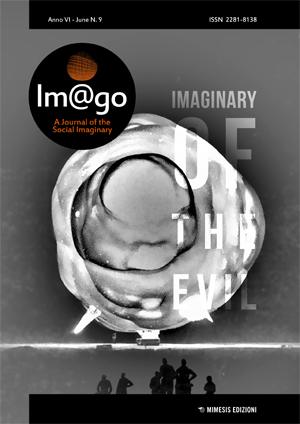
Utilità e danno della “parte maledetta” nell’economia dell’immaginario
DOI:
https://doi.org/10.13129/2281-8138/2017.0.72-89Parole chiave:
Sacrifice, Dépense, Gift, Autotrascendence, Economic general theoryAbstract
About the utility and liability of the “accursed share” in the economy of imaginary. The “Evil” as excess, waste, total consumption; or “bad”, “accursed” because it destabilizes the current “state of affairs”. This essay is intended to expose the economic theory of G. Bataille by a short reading of The limit of utility and of The Accursed share, where he explains his theory of a “general economy” in opposition to what he called the “restricted economy”, corresponding to the whole of economic sciences. According to the fact that economics just study production/extraction, distribution and consumption of matters and goods by the narrow scope of the “isolated situation” of individualistic interest, he tries to go further beyond this classical perspective with a redefinition of the evaluation/exploitation process and the relation between useful and useless. In this way he discovers the paradox of prosperity, its curse: prosperity is “excess” (prodigality) but it’s always destined to became “waste” (squandering). Finally a reading back of Bataille’s insights it is carried out through a comparison with the analysis M. Anspack runs in his A charge de revanche, a book in which he outlines a wide overview of reciprocity in human relationships and in economic phenomena.
Dowloads
Pubblicato
Fascicolo
Sezione
Licenza
Quest'opera è distribuita con Licenza Creative Commons Attribuzione 4.0 Internazionale.
L'autore conserva il copyright sul suo contributo, consentendo tuttavia a chiunque "di riprodurre, distribuire, comunicare al pubblico, esporre in pubblico, rappresentare, eseguire e recitare l'opera", purché siano correttamente citati l'autore e il titolo della rivista.
L’autore, al momento della proposta di pubblicazione, è inoltre tenuto a dichiarare che il contenuto e l’organizzazione dell’opera è originale e non compromette in alcun modo i diritti di terzi, né gli obblighi connessi alla salvaguardia di diritti morali ed economici di altri autori o di altri aventi diritto, sia per testi, immagini, foto, tabelle, sia per altre parti di cui il contributo può essere composto. L’autore dichiara altresì di essere a conoscenza delle sanzioni previste dal codice penale e dalle leggi speciali per l’ipotesi di falsità in atti ed uso di atti falsi, e che pertanto la rivista è esente da qualsiasi responsabilità di qualsivoglia natura, civile, amministrativa o penale, e sarà dall'autore tenuta indenne da qualsiasi richiesta o rivendicazione da parte di terzi.