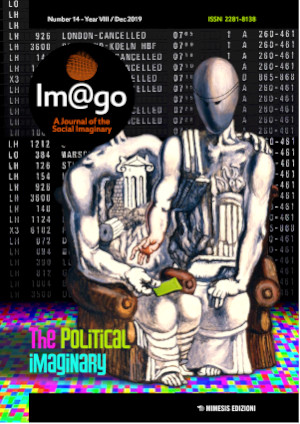
The Double Instance of the Political. Imaginary – affects as rhetorical means and structure
DOI :
https://doi.org/10.7413/22818138160Résumé
Although emotions are linked to irrationality, a number of recent researches have shown emotions are central to political behaviour. While as politics is an emotionally dense sphere of individual and collective action, any fuller comprehension of the political imaginary must ponder it.
This paper considers the emotional dimension of the political imaginary according to a dual rhetorical instance: the use of emotions as tools (emotional appeals) to influence behaviour and thinking; and the very affective nature of politics as such. In other words, I will examine affects as rhetorical means and as structuring elements of the political imaginary.
By referring to empirical political messages – from the Daisy Ad until the election of the comedian actor Volodymyr Zelensky as President of Ukraine - it is claimed that the political imaginary is not just about collective reasoning. The political imaginary is also something that we feel. This paper intends to clarify how affects help to determine collective feeling and, consequently, political decision making and social understanding
Téléchargements
Publiée
Numéro
Rubrique
Licence
T
This work is distributed under the Creative Commons Attribution 4.0 International License.
The author retains the copyright to their contribution, while allowing anyone “to reproduce, distribute, communicate to the public, publicly display, perform, execute and recite the work”, provided that the author and the title of the journal are properly acknowledged.
At the time of submitting the publication proposal, the author is also required to declare that the content and structure of the work are original and do not in any way infringe upon the rights of third parties, nor the obligations related to the protection of the moral and economic rights of other authors or rights holders, whether concerning texts, images, photographs, tables, or any other parts of which the contribution may consist.
The author further declares that they are aware of the penalties provided for under the criminal code and special laws in the event of false statements in official documents and the use of false documents. Therefore, the journal shall be exempt from any liability of any kind, whether civil, administrative, or criminal, and the author shall hold the journal harmless from any request, claim, or demand made by third parties.
Authors who publish with this journal agree to the following terms:
- Authors retain copyright and grant the journal right of first publication with the work simultaneously licensed under a Creative Commons Attribution License that allows others to share the work with an acknowledgement of the work's authorship and initial publication in this journal.
- Authors are able to enter into separate, additional contractual arrangements for the non-exclusive distribution of the journal's published version of the work (e.g., post it to an institutional repository or publish it in a book), with an acknowledgement of its initial publication in this journal.
- Authors are permitted and encouraged to post their work online (e.g., in institutional repositories or on their website) prior to and during the submission process, as it can lead to productive exchanges, as well as earlier and greater citation of published work (See The Effect of Open Access).