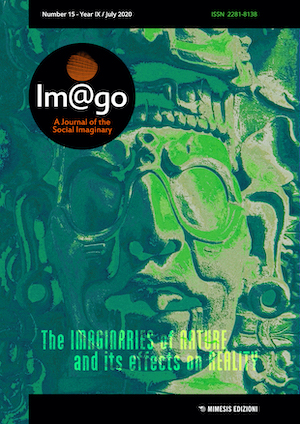
The urgency of recovering contemplation. New Media Art and the transformation of nature into landscape
DOI:
https://doi.org/10.7413/22818138167Palabras clave:
Landscape | Nature | New Media Art | Contemplation | Visual ArtsResumen
Adam Basanta is the author of the installation named Landscape Past Future, exhibited at the gnration gallery in Braga, Portugal, between 23 October and 11 January 2020. This artistic project is based on images of works of art (landscape painting and photography) from the main institutional collections, publicly available, used to create new digital landscapes. Applying custom digital mosaic software, small data sets were placed and rearranged on a virtual screen to create a new aggregate image. Starting from this case, we intend to investigate how the landscape genre, remedied by the new media art, challenges us to reframe both nature and landscape ideas, in contemporary times. This article aims to discuss the role of new technologies as a medium that can help us to recover the exercise of contemplation, and to transform « nature » into « landscape », as an action of seeing and thinking, after all the first step to really act, with a sense of urgency, on our unsustainable habitat.
Descargas
Publicado
Número
Sección
Licencia
T
This work is distributed under the Creative Commons Attribution 4.0 International License.
The author retains the copyright to their contribution, while allowing anyone “to reproduce, distribute, communicate to the public, publicly display, perform, execute and recite the work”, provided that the author and the title of the journal are properly acknowledged.
At the time of submitting the publication proposal, the author is also required to declare that the content and structure of the work are original and do not in any way infringe upon the rights of third parties, nor the obligations related to the protection of the moral and economic rights of other authors or rights holders, whether concerning texts, images, photographs, tables, or any other parts of which the contribution may consist.
The author further declares that they are aware of the penalties provided for under the criminal code and special laws in the event of false statements in official documents and the use of false documents. Therefore, the journal shall be exempt from any liability of any kind, whether civil, administrative, or criminal, and the author shall hold the journal harmless from any request, claim, or demand made by third parties.
Authors who publish with this journal agree to the following terms:
- Authors retain copyright and grant the journal right of first publication with the work simultaneously licensed under a Creative Commons Attribution License that allows others to share the work with an acknowledgement of the work's authorship and initial publication in this journal.
- Authors are able to enter into separate, additional contractual arrangements for the non-exclusive distribution of the journal's published version of the work (e.g., post it to an institutional repository or publish it in a book), with an acknowledgement of its initial publication in this journal.
- Authors are permitted and encouraged to post their work online (e.g., in institutional repositories or on their website) prior to and during the submission process, as it can lead to productive exchanges, as well as earlier and greater citation of published work (See The Effect of Open Access).